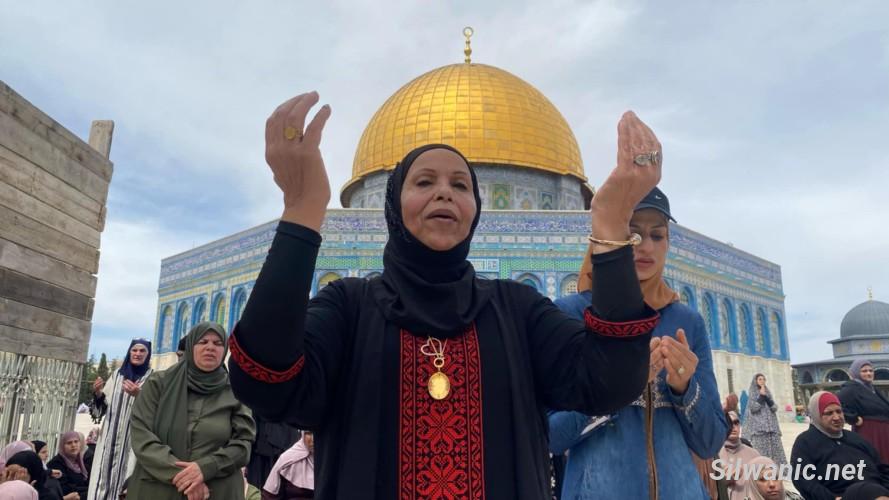
Last Friday of Ramadan: Decrease in the number of Worshippers at Al-Aqsa Due to Israeli Restrictions and Measures
Israeli restrictions and measures prevented worshippers from reaching Al-Aqsa Mosque on the last Friday of Ramadan, leading to a noticeable decline in the number of attendees.
According to the Islamic Waqf Department, 75,000 worshippers attended the fourth and final Friday prayer of Ramadan at Al-Aqsa, while 100,000 performed the Isha and Tarawih prayers and completed the Quran recitation on the 28th night of the holy month.
In previous years, based on observations and estimates by the Islamic Waqf, the number of worshippers on Fridays was significantly higher, often exceeding a quarter of a million. The same applies to Laylat al-Qadr (the Night of Decree). However, this year saw a decrease, with 90,000 attending the first Friday prayer of Ramadan, 80,000 on the second and third Fridays, and 75,000 on the last Friday, while 180,000 worshippers attended Laylat al-Qadr prayers.
This decline is attributed to stringent restrictions and measures imposed on Palestinians from the West Bank, who were required to obtain a magnetic card and a permit through the Israeli “Coordinator” application. The permits were restricted to Fridays only, valid from 5:00 AM to 5:00 PM, and required worshippers to return through the same checkpoint where they had entered to confirm their return to the West Bank through fingerprint verification. According to Israeli statements, only 10,000 worshippers were allowed to enter.
Regarding age restrictions, men under 55 and women under 50 were denied entry, while children under 12 were permitted only if accompanied by a guardian and presented a birth certificate.
Worshippers from the West Bank reported that the actual number of those allowed to enter was even lower than announced. They had to apply for permits through the Coordinator app, but many applications were rejected for reasons such as “technical issues” or “quota being full.” Many families were also denied permits inconsistently—for example, a father might be allowed in while his children were denied, or a wife might receive a permit while her husband was refused, and vice versa.
Additionally, some worshippers reported receiving phone calls or home raids in recent weeks to verify their return after obtaining a Friday permit. Israeli authorities reportedly prevented many from securing permits for multiple Friday prayers, allowing them to enter for only one Friday during the month.
On this final Friday, worshippers from the West Bank were also prevented from performing the Asr prayer at Al-Aqsa or staying in the mosque after the Friday prayer due to the daylight saving time change in Jerusalem. This time difference of one hour between Jerusalem and the West Bank forced worshippers to leave Al-Aqsa immediately after Friday prayers to reach the checkpoints at the entrances to the city before their permits expired.
In addition to the restrictions imposed on West Bank residents, Gazans have been completely denied access to Jerusalem for years. Meanwhile, residents of Jerusalem and the Palestinian interior face arbitrary restrictions, often being randomly denied entry upon reaching the gates of the Old City or Al-Aqsa. In the lead-up to Ramadan and throughout the month, Israeli authorities also issued numerous ban orders, prohibiting many individuals from accessing the mosque.
Israeli authorities militarized the Old City and its surroundings as well as Al-Aqsa and its surroundings, deploying thousands of security forces across streets and alleys. Roads adjacent to the Old City and nearby neighborhoods were blocked, and vehicles and public transportation were prohibited from entering.
Raid on Al-Aqsa and Detention of Waqf Employees’ and Journalists’ identification cards
During the Friday sermon and prayers, Israeli forces stormed Al-Aqsa Mosque to object to the presence of Islamic Waqf employees and journalists on the roof of the Qibli Prayer Hall.
Firas Al-Dibs, an employee of the Islamic Waqf, stated that several Waqf staff and journalists had gone up to the roof of the Qibli Prayer Hall to cover the Friday prayers, as they do every week and every year. While they were documenting and photographing the worshippers, Israeli forces objected to their presence and threatened to raid the mosque and ascend to the roof, demanding they immediately leave the area.
Al-Dibs added that while him and his colleagues prepared to exit the rooftop, more Israeli forces were stationed at the door and detained the identification cards of everyone present in the area, threatened to expel them from Al-Aqsa, shouted at them, insulted them, and confiscated the key to the door leading to the rooftop of Al-Qibli hall.
More than an hour later, the journalists' identification cards and the confiscated key were returned. However, Al-Dibs was summoned for immediate interrogation at the Qishla police station in the Old City of Jerusalem.
Following his detention and interrogation, he was released under the condition that he stays away from Al-Aqsa for one week. Authorities also scheduled a follow-up investigation on April 6, 2025, with the possibility of extending the ban order.