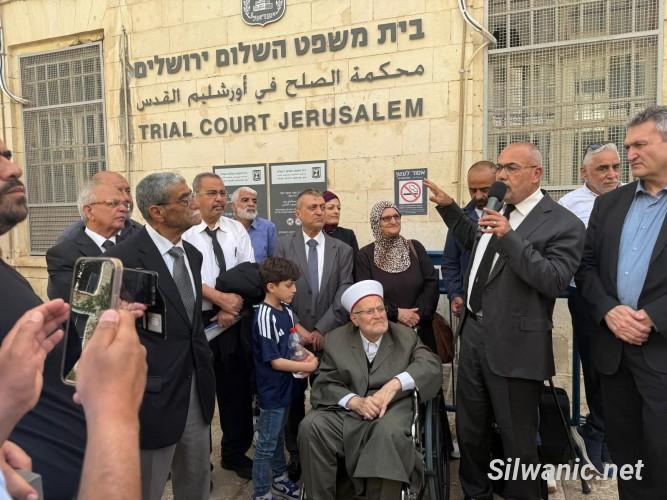
The trial of Sheikh Ekrima Sabri has been postponed until September 2026, and the defense refutes the indictment
On Sunday, a hearing took place in Sheikh Ekrima Sabri's trial, where he is accused of "incitement to terrorism" for delivering condolence messages at the mourning tents of martyrs Uday Tamimi in Jerusalem and Raed Khazem in Jenin in 2022, as well as for his eulogy of Hamas leader Sheikh Ismail Haniyeh at Al-Aqsa Mosque in 2024. The court postponed the session until September 7, 2026, to allow the prosecution to present its witnesses.
Sheikh Ekrima Sabri: A deliberate mix of supplication and information, and a distortion of words aimed at incitement
Sheikh Ekrima Sabri declared: "Our speeches are rooted in religious language, and the distortion is a clear provocation aimed at inciting violence and launching a harsh, unfair media smear campaign against me." He further explained: "The allegations against me confuse information with supplication. Supplication starts with 'O God,' which is an appeal and prayer to God, but they interpret it as incitement."
He went on: "When we pray, 'O God, have mercy on our martyrs,' they see it as an accusation, even though we've said it for thousands of years. They manipulate our words to provoke and distort reality. We uphold the truth—our strength lies in it—and we stand on the side of righteousness, refusing to retreat."
Attorney Zabarqa: The defense's response completely refuted the charges against Sheikh Ekrima Sabri
Attorney Khaled Zabarqa, part of Sheikh Ekrima Sabri's defense team, stated that today's session focused on the defense's response to the three charges in the indictment against the Sheikh.
Zabarqa stated: "The response was straightforward: we oppose the charges against Sheikh Ekrima Sabri because he did not break any laws. In fact, the speeches he delivered at mourning gatherings in Jerusalem and Jenin, as well as his condolences for Haniyeh at Al-Aqsa Mosque, constitute legitimate expressions of dialogue that should be legally safeguarded."
He remarked that filing an indictment in these cases is part of a wider effort to suppress freedom of opinion and expression, particularly targeting religious and national figures in Jerusalem. Among them, Sheikh Ekrima stands out as a symbol of Jerusalem and Palestine, consistently voicing the local community's sentiments and emphasizing religious principles and texts.
Zabarqa also mentioned that the defense team offered a detailed explanation and rebuttal of the indictment's clauses, labeling them as "incorrect," and noted that the court scheduled a hearing for 7/9/2026 to hear the prosecution's witnesses.
He added, "This case will require several sessions until we prove to the court that there is no wrongdoing."
He emphasized that Sheikh Ekrima Sabri is facing religious, legal, and political persecution. He also pointed out that extremist Jewish groups with influential roles in the government aim to access Al-Aqsa Mosque by persecuting religious leaders and trying to neutralize them.
The defense team characterized the hearing as "an incitement campaign aimed at silencing Sheikh Ekrima and removing his role as a defender"
Sheikh Ekrima Sabri's defense team argued that this session is part of a "series of political persecution measures" aimed at targeting religious and national leaders, with the goal of silencing their efforts to defend Jerusalem and Al-Aqsa Mosque.
The team stated, "His Eminence the Sheikh, aged 87, is a leading religious and intellectual figure standing for national and religious principles in Jerusalem and Al-Aqsa. He faces relentless incitement by extremist Jewish groups trying to silence his voice and diminish his role as a defender and advocate of the blessed Al-Aqsa Mosque." The defense emphasized that this prosecution is "political and racist," aiming to "shift Islamic discourse concerning Jerusalem and Al-Aqsa by targeting prominent religious and national leaders."