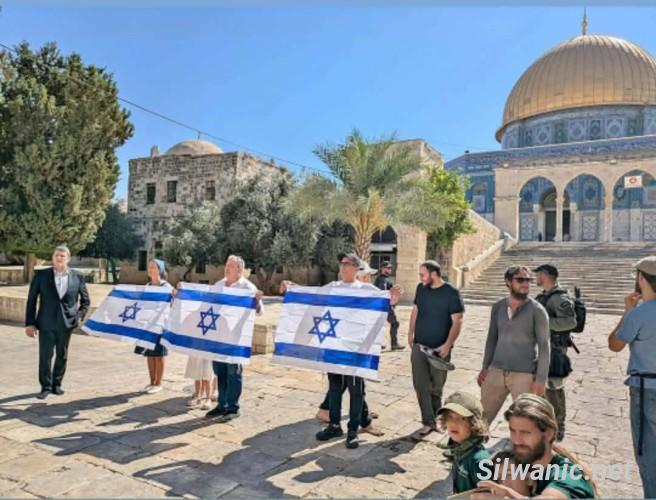
On the anniversary of the “Destruction of the Temple,” 4,288 settlers, including ministers and Knesset members, stormed Al-Aqsa Mosque, transforming its courtyards into public Jewish prayer areas
On the anniversary known as the "Destruction of the Temple," Al-Aqsa Mosque experienced a significant escalation in incursions. The storming on Thursday involved not only a record number of intruders but also a qualitative change in how violations occurred. Religious rituals were conducted across most of the mosque's courtyards, group prayers took place in several locations, Israeli flags were displayed, and religious items, clothing, and prayer books were brought inside. Israeli officials, including ministers and Knesset members, led these rituals from within the mosque, while thousands of Muslims were denied access due to occupation restrictions.
During the day, 4,288 settlers stormed Al-Aqsa Mosque, divided between two incursion periods.
• 3,228 settlers during the morning period (7:00 – 11:30).
• 1,060 settlers during the afternoon period (1:30 – 3:15).
Key participants in the raid included: National Security Minister Itamar Ben-Gvir, Minister for the Development of the Negev and Galilee Yitzhak Wasserlauf, Likud MK Amit Halevi, Official Right MK Sharren Haskel, and Likud Deputy Speaker of the Knesset Nissim Vatori.
Group prayers and public rituals throughout the Mosque
Al-Aqsa Mosque experienced an unprecedented increase in Talmudic rituals, with its courtyards largely converted into spaces for group and public prayers. Settlers carried out their prayers starting from their entry through the Dung Gate until their departure via the Al-Silsileh Gate.
Settler groups paused at different spots inside the mosque, especially near the areas overlooking the Dome of the Rock. There, they conducted group prayers, danced, sang, clapped, wailed, prostrated together, and openly chanted religious hymns.
New sections within the mosque saw the start of group prayers, especially the space between the Al-Qibli and Al-Marwani Prayer Halls, as well as along the eastern and western arcades. This change highlights the increasing inclusion of Jewish ritual practices within the mosque.
The eastern area... establishing the "undeclared synagogue"
Temple Mount groups kept establishing the eastern part of Al-Aqsa Mosque as a permanent location for daily and group Jewish prayers, an area now referred to by extremist groups as the "Undeclared Synagogue."
During the incursion, a canopy was set up in the eastern area, where settlers gathered to pray and perform religious rituals. This action indicates ongoing efforts to establish this location as a permanent Jewish place of worship within the Al-Aqsa Mosque.
The area also saw the reading of the Book of Lamentations, a Jewish religious text with five chapters, performed on the ninth of Av, which marks the remembrance of the Temple's destruction.
"Lamentations and Prayers for the Commemoration of the Destruction of the Temple" textbooks in Al-Aqsa
Images shared on platforms associated with extremist Temple Mount groups depicted several settlers storming the Al-Aqsa Mosque. They carried Talmudic texts and prayer books into the mosque's courtyards and openly read them in front of the Dome of the Rock.
The images depicted settlers holding copies of "Lamentations and Prayers Commemorating the Destruction of the Temple" and reading Torah passages from the morning prayer during their tours of the courtyards, while heavily guarded by Israeli occupation police.
Bringing in ritual items and clothing
The Israeli occupation police permitted dozens of settlers to bring religious items and clothing into the Al-Aqsa Mosque for use during prayers. These items included tefillin wraps, which are black leather containers with Torah verses, tied to the arm and forehead during prayer, and tallit, a Jewish prayer shawl worn as a symbol of purity and devotion.
Raising Israeli flags
Dozens of settlers raised Israeli flags inside the Al-Aqsa Mosque during the incursion. Israeli flags and flags of the so-called "Temple" were also raised on the mosque's outer gates. Ministers and Knesset members led group prayers, participated in raising the flags, and addressed the intruders.
Over 1,000 settlers were inside the mosque simultaneously, spread across various courtyards and pathways in the Al-Aqsa.
Ben-Gvir's statements
National Security Minister Itamar Ben-Gvir spoke from inside the Al-Aqsa Mosque, facing the Dome of the Rock, and praised what he called "tremendous progress" in establishing Israeli sovereignty over the mosque.
He said, "We pray here and feel as if we own the place, something that was not true before."
He mentioned that the Israeli government aims to establish "full sovereignty" in Jerusalem and committed to maintaining this policy.
Fatori: Control of Al-Aqsa is the foundation for control of the West Bank
Knesset Deputy Speaker Nissim Fatori emphasized that controlling the Al-Aqsa Mosque is fundamental to establishing Israeli control over the West Bank.
In his televised remarks from inside the mosque, he stated, "If we don't take control of this mountain, we won't have control over anything. Control here is essential and forms the basis for governing Judea and Samaria."
He also spoke to the Israeli right wing, stating, "The others will be merely our guests," and advocated for creating a permanent Jewish presence at the Al-Aqsa Mosque.
Strict restrictions on Muslims’ entry
At the same time as the incursions, the occupation authorities began restricting Muslim access to Al-Aqsa Mosque from dawn.
They barred men under 65 from entry, turned away dozens of worshippers at the mosque gates after verifying their IDs, and opened the Hutta and Al-Majles Gates for worshippers while keeping the Al-Silsileh Gate closed, as is usual for dawn prayers.
In the afternoon, restrictions were intensified, allowing only individuals over 70 years old to enter, with ongoing identity verification.
Since the morning, police have closed the King Faisal Gate, the Al-Qataneen Gate, and the Al-Hadeed Gate. Settlers gathered at these gates for their group prayers, which they referred to as "prayers from the outside."
Settler march on the eve of the incursion
Late last night, a settler march took place on the eve of what they refer to as the "Destruction of the Temple" commemoration. The march started at Mamilla Square in West Jerusalem, passing through the New Gate area, Damascus Gate, Herod's Gate, and Lions' Gate, before arriving at the Al-Buraq Wall courtyard.
Thousands of settlers prayed at the Al-Buraq Wall, outside the gates of the Al-Aqsa Mosque, and in Al-Ghazali Square. They also displayed Israeli flags and flags of the so-called "Temple," while chanting religious hymns and songs.
During their nighttime march, the settlers attacked Palestinians and caused damage to their property.