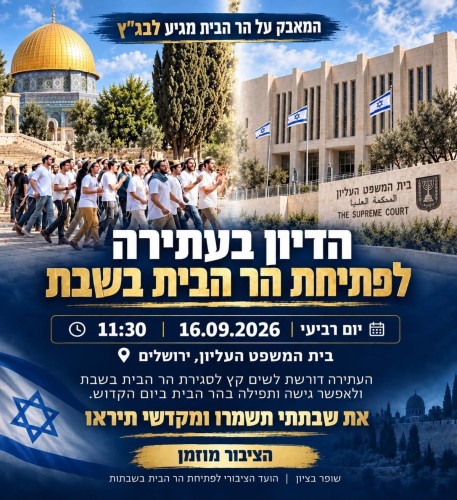
Supreme Court considers petition to open Al-Aqsa on Saturdays; escalation in incursions, rituals, and expulsions during Jewish holidays
On Wednesday, September 16, 2026, the Israeli Supreme Court will hear a petition filed by the "Shofar Betzion" organization and the "Public Committee for Opening the Temple Mount on Saturdays." The petition calls for lifting the restrictions that prevent settlers from entering the Al-Aqsa Mosque on Saturdays.
The petition requests a court order requiring the police and authorities to end the ban on Jewish visits to Al-Aqsa Mosque on Saturdays and to allow them to enter and pray in its courtyards on that day.
The hearing is set for 11:30 AM. At the same time, extremist "Temple" groups have urged their supporters to gather outside the Israeli Supreme Court during the proceedings, encouraging a large turnout to "fill the courtroom." They also plan to hold a rally and prayer service outside the building, displaying flags linked to these "Temple" groups.
The groups issued a call petitioning to end the Saturday closure of what they call the "Temple Mount" and to permit entry and prayer there on that day. Their slogan, "Keep the Sabbath and sanctify My sanctuary," reflects their assertion of a religious right to access and pray at Al-Aqsa Mosque.
Calls to open Al-Aqsa on Saturdays and an escalation in incursions during the holidays
These calls occur amid rising pressure from "Temple" groups, who are requesting extended incursion hours into the Al-Aqsa Mosque, including opening its gates to settlers on Saturdays, a day when incursions usually stop.
Settler incursions into the Al-Aqsa Mosque and the Al-Buraq Wall persist on the ground, coinciding with the Jewish holiday season that started with Rosh Hashanah. On Thursday, the eve of the holiday, 417 settlers stormed the mosque, followed by 545 settlers on Sunday, the New Year’s day, despite the usual pause in incursions on Fridays and Saturdays.
During Sunday’s incursions, settlers conducted public, collective prayers throughout the Al-Aqsa Mosque—covering different courtyards, corridors, and spots overlooking the Dome of the Rock. Their route began at the Dung Gate (the entry point for incursions), then moved across the Al-Qibli Prayer Hall courtyard, the roof of the Al-Marwani Prayer Hall, and reached the eastern section.
The largest collective prayers occurred mainly in the eastern area, where ritual horns (shofars) were blown; police allowed over 200 settlers to assemble there at the same time for these group prayers.
The prayers stretched along the north side of the Al-Aqsa Mosque and reached the western corridors before the group left through the al-Silsileh Gate.
The prayers included singing, clapping, forming circles, prostrating, and reciting from religious texts. At the same time, the sounds of settlers' voices were clearly audible inside the Al-Aqsa Mosque, which was mostly empty except for a few elderly worshippers. These elders were confined to specific seating areas and prohibited from sitting along the routes of the incursions. Some worshippers were even driven into the covered prayer halls and kept from staying in the open courtyards.
Websites linked to extremist "Temple" groups reported smuggling ritual horns into the Al-Aqsa Mosque courtyards during the Jewish New Year. These included "Shofar" horns made from ram's horns and straight silver trumpets called "Hatzotzrot."
Based on the groups' reports, these instruments were played at the same time from within the Al-Aqsa Mosque courtyards and outside the mosque's eastern wall, particularly near the Bab al-Rahma Cemetery. This marks the sixth year in a row that such horns have been sounded within the Al-Aqsa Mosque.
Tightened restrictions on worshippers’ entry
Israeli restrictions started on Sunday at dawn during the prayer, with forces preventing those under 60–65 from entering Al-Aqsa Mosque. They increased identity checks for all arrivals during the dawn and noon prayers, which mostly blocked people from entering the mosque.
Ongoing expulsions from Al-Aqsa Mosque
At the same time, occupation authorities continue to issue orders banning Palestinians from entering Al-Aqsa Mosque. Recent bans have affected individuals including Nasim Hamada, Yousef Al-Risheq, Suhaib Afana, Amin Al-Abbasi, Yaqoub Abu Asab, Huthaifa Attoun, as well as Al-Aqsa Mosque guards Fadi Alayan and Samer Abu Qweider. Others impacted are Amin Al-Abbasi (who is in his seventies), Hamza Jabr Al-Abbasi, Mohammad Zalloum, Saleh Majid Abu Al-Homs, and Yazan Jaber.
Some of these orders mandate a six-month ban from Al-Aqsa Mosque, accompanied by a map delineating the areas the individual is prohibited from accessing during the ban period; these restricted areas include all corridors and pathways leading to the mosque.
Others also received ban orders but preferred not to have their names disclosed.
These ban orders are part of an ongoing policy targeting worshippers, activists, staff members, and released prisoners associated with Al-Aqsa Mosque, coinciding with an escalation of Israeli measures during the Jewish holiday season.
Preparations for upcoming incursions
"Temple" groups are ongoing in issuing calls and preparing to carry out incursions into the Al-Aqsa Mosque and the Al-Buraq Wall in the upcoming days. These activities are timed to coincide with Yom Kippur and Sukkot, amidst calls for performing religious rituals within the Al-Aqsa Mosque and nearby areas.