Al-Aqsa and the Church of the Holy Sepulcher reopen after weeks of closure… a bittersweet joy as incursions resume
Following a 40-day closure and state of emergency, the Al-Aqsa Mosque and the Church of the Holy Sepulcher in Jerusalem reopened at dawn on Thursday, one day after the United States and Iran declared a two-week ceasefire.
3,000 worshippers perform Fajr prayer… and Al-Aqsa is bustling with worshippers throughout the day
At dawn, thousands of worshippers gathered at the Al-Aqsa Mosque to perform the Fajr prayer after weeks of being unable to do so due to restrictions. Worshippers came from Jerusalem and the Palestinian territories within Israel and managed to pray in Al-Aqsa. The Islamic Endowment Department estimated the crowd at around 3,000 worshippers at dawn, with attendance increasing throughout the day.
Al-Aqsa was filled with a sense of joy and spiritual peace, as life resumed in its prayer halls, arcades, and courtyards following a lengthy period of closure.
After Al-Aqsa Mosque was reopened, its courtyards displayed striking scenes, with wild herbs and mallow growing densely and tall in many areas due to the prolonged closure and the absence of worshippers. As life returned, worshippers eagerly fed the birds and cats that seemed accustomed to the courtyards during the closure, while others gathered mallow and took photos to capture these natural scenes that brought a special atmosphere to Al-Aqsa.
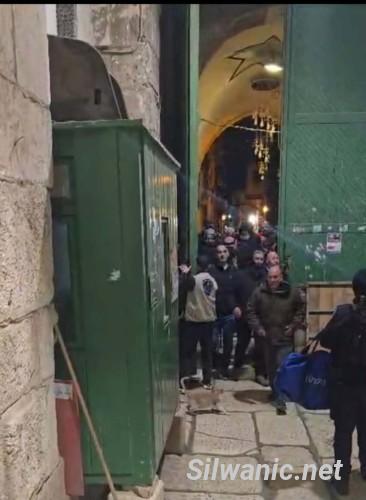
Although the mosque reopened, the atmosphere remained tense due to harassment and violations. From early morning, Israeli forces were stationed at the gates and along the roads leading to the mosque. Eyewitnesses described young men being assaulted, beaten, and detained, and also subjected to "physical searches" —a form of torture where individuals are forced to stand against walls. Many people underwent identity checks before being permitted entry.
Arrests took place in the courtyards and at the gates of Al-Aqsa Mosque, targeting young men, boys, and women from Jerusalem and the Palestinian territories within Israel. About 17 detainees were held throughout the day and later released with the condition that they get deported from Jerusalem or the Al-Aqsa Mosque.
488 settlers stormed Al-Aqsa... prayers, dancing, and an extension of the incursions
Just hours after the mosque reopened, the incursions resumed. The Islamic Endowment Department reported that 488 settlers stormed Al-Aqsa during the morning and afternoon incursion periods.
During the incursions, many violations were documented, including public prayers, singing, dancing, and prostration in various parts of the Al-Aqsa Mosque complex. Moreover, areas with views of the Dome of the Rock were used for loud group prayers. The sounds of singing and prayers echoed across the mosque's courtyards.
Based on announcements and circulars from groups linked to the alleged "Temple Mount" movement, the incursions are planned from 6:30 AM to 11:30 AM and from 1:30 PM to 3:00 PM. This indicates a half-hour extension in the daily incursions, now starting at 6:30 AM instead of 7:00 AM.
Church of the Holy Sepulcher welcomes worshippers
In the same context, the Church of the Holy Sepulcher reopened on Thursday morning, hosting the return of Easter services, a significant Christian holiday. These services feature annual masses and religious rituals. Nevertheless, this year's atmosphere was subdued due to the lack of international pilgrims and the denial of entry for thousands of Palestinian Christians from the West Bank, stemming from permit restrictions.
Both Islamic and Christian holy sites were shut down shortly after the US-Israeli conflict with Iran began. Worshippers were expelled from the start, and the closures occurred during Ramadan, hindering Muslims from prayers, spiritual retreats, and holy night observances. They were also barred from performing the Eid prayer, and Friday prayers were stopped for five consecutive weeks.
The Church of the Holy Sepulcher was shuttered, depriving Christians of their Easter services. In a serious incident, police barred Cardinal Pier Battista Pizzaballa, head of the Catholic Church in the Holy Land, and Father Francesco Ilbo, Custos of the Holy Land, from entering the church while they were on their way to celebrate Palm Sunday Mass, despite having previous coordination and arrangements.