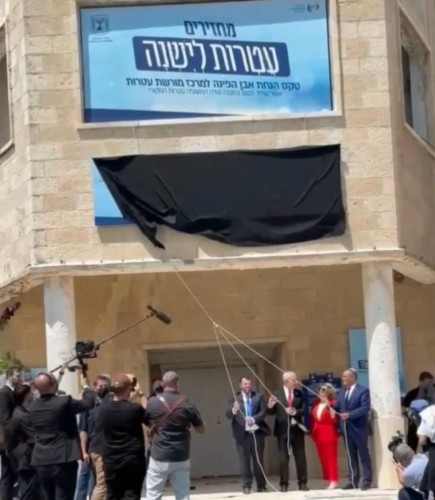
Coinciding with the anniversary of Entebbe, Netanyahu launches a "Heritage Center" project in Qalandia
Israeli Prime Minister Benjamin Netanyahu laid the cornerstone on Sunday for a "Heritage Center" located within the reception building of the historic Jerusalem International Airport in Qalandia, north of Jerusalem. The event was attended by Israeli Heritage Minister Amihai Eliyahu and Jerusalem Mayor Moshe Lion.
The project is located within the historic airport building, one of Palestine's oldest aviation sites. Established in 1920 during the British Mandate, it later served as Jerusalem's primary civilian airport. Under Jordanian rule, the airport was expanded and improved until its control shifted to Israel after the 1967 occupation of Jerusalem. Subsequently, the airport was gradually shut down and fell into disuse in the northern part of the city, though the building still stands today.
Based on official statements and Hebrew media reports, the project aims to convert the airport's reception building into the "Heritage Center," a space dedicated to tourism, heritage, and education. This center will showcase exhibits on Jerusalem and regional aviation history, along with displays relating to Israel's perspective on the "history of settlement" in northern Jerusalem. It will also feature educational and cultural areas for visitors, transforming the historic structure within a new contextual narrative.
The project features a dedicated wing honoring Yoni Netanyahu, Prime Minister Benjamin Netanyahu's brother, who was killed during Operation Entebbe in 1976. This renowned military operation, one of the most notable in history, is symbolically connected to its 50th anniversary, which imbues the event with a celebratory and political significance in official Israeli narratives.
Israeli Heritage Minister Amichai Eliyahu started the project, aligning with the 50th anniversary of Operation Entebbe, a military rescue in Uganda where Palestinians hijacked a plane.
During the ceremony, Netanyahu stated that the project was part of "restoring glory to Atarot," highlighting his government's efforts to enhance the Israeli presence in northern Jerusalem. He emphasized that "a united Jerusalem will never be divided again." Additionally, he connected the establishment of the center to other development initiatives in the city, viewing it as a means to reinforce the Israeli narrative in Jerusalem.