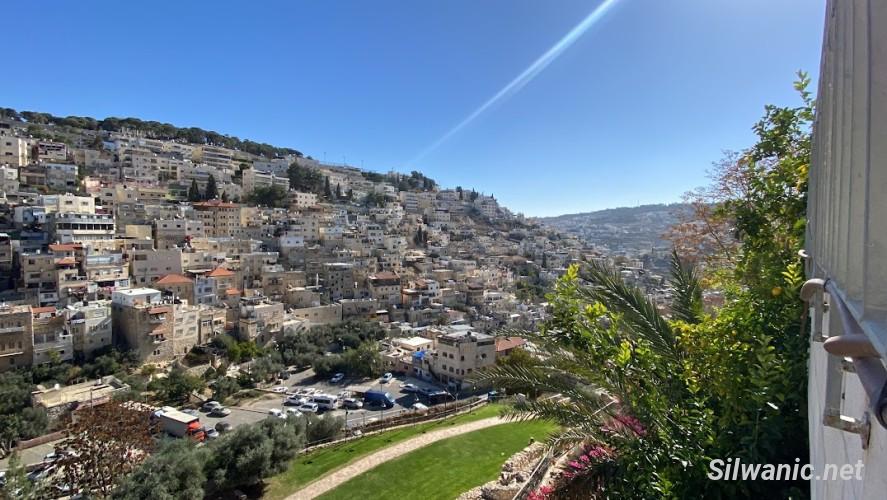
After demolishing residential and commercial structures, the occupation seizes 4.7 dunams in Al-Bustan neighborhood as part of the "King's Garden" plan
Joint teams from the Israeli municipality, along with special forces and police, raided the Al-Bustan neighborhood in Silwan, south of the Al-Aqsa Mosque, and placed a temporary seizure order on land owned by the Taweel family.
The Wadi Hilweh Information Center in Jerusalem reported that authorities issued an administrative order from the Jerusalem mayor to temporarily take control of about 4.7 dunams of vacant land in the Al-Bustan neighborhood of Silwan, known by the Israelis as the “King's Garden”. The order, justified by the need for cleaning, landscaping, and creating a public open space, highlights ongoing land management actions.
The order, issued on July 5, 2026, and directed to landowners, explained that the municipality responded under the Local Authorities Law of 1987, which allows for temporary land use. It justified this by stating that the area required green spaces and public parks for residents and pedestrians, referencing its designation as an open public space in a structural plan from 1977.
The center mentioned that the land in question is owned by the Al-Taweel family, which last year received final demolition orders for their existing structures. These include homes, a commercial building called "Al-Taweel Garage," and several residential rooms, one dating back to 1975, along with other houses and structures that the municipality has denied building permits for.
The document states that the seizure order remains valid for five years from the start of landscaping work. During this time, landowners are not required to pay property taxes ("Arnona'). The decision asserts that this process does not violate private property rights and that owners can reclaim the land if they secure a valid building permit.
The decision also provides landowners and those affected with only 30 days from the date of issuance to file objections or legal appeals. These actions are part of the occupation municipality’s plans to execute settlement projects in the area, which include creating parking lots and gardens for settlers. Field data indicates that the municipality has shifted from issuing and enforcing demolition orders to actively bulldozing and confiscating land, a process that has been ongoing since last April.
The plan to target the Al-Bustan neighborhood originated in 2004, when the Israeli municipality decided to demolish it entirely to make way for the "King's Park" project. In 2005, demolition notices were sent to residents, but the project was subsequently halted due to international pressure, human rights concerns, and diplomatic efforts.
For over twenty years, neighborhood residents fought legal and practical battles to block the plan. They worked with engineers and lawyers to propose alternative zoning options, such as opening streets and dedicating land for public facilities like schools and playgrounds. Nevertheless, the Israeli municipality rejected these proposals in March 2021 and declined to extend the halt on demolition orders, an action residents viewed as a breach of earlier agreements.
The Wadi Hilweh Information Center reported that around 60 structures, mainly residential, were demolished in Al-Bustan over the last two years, displacing about 300 Palestinians. Remaining residents continue to face demolition threats, as Al-Bustan originally had 115 homes. This indicates that the occupation authorities have demolished over half of the neighborhood’s homes so far.