Day 4 of Sukkot: 1,438 settlers stormed Al-Aqsa; Jewish rituals expand at Al-Aqsa and the eastern area
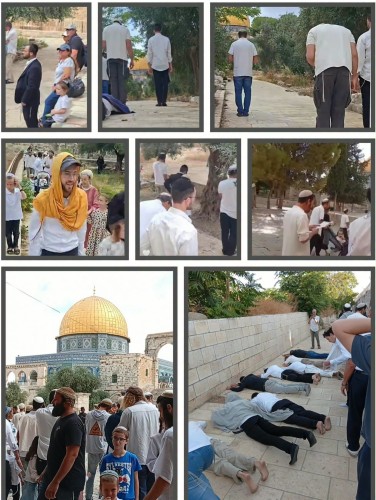
On Tuesday, the fourth day of the Jewish holiday of Sukkot, hundreds of settlers carried out large-scale, successive incursions at Al-Aqsa Mosque. They engaged in collective prayers, hymns, singing, clapping, slogan-chanting, and religious rituals in various parts of the mosque. The eastern area became a focal point for lingering and performing prayers and rituals, as strict measures were imposed to clear Muslim worshippers from Al-Aqsa and its surroundings and secure the incursions.
The Wadi Hilweh Information Center-Jerusalem reported that 1,438 settlers stormed Al-Aqsa Mosque today. Of these, 966 were during the morning session (6:30 AM to 11:30 AM), and 472 during the afternoon session (1:30 PM to 3:00 PM). All passed through the Dung Gate, whose keys have been controlled by the occupation authorities since Jerusalem was occupied.
The incursions occurred in successive groups of 70 to 120 individuals. Up to four groups were allowed inside the mosque at the same time, in separate locations, ensuring a continuous flow of settlers during the designated incursion hours.
A long route and rituals spanning the Al-Aqsa
The center reported that most intruders completed a full circuit of the mosque, entering through Dung Gate, passing through the courtyards and the southern, eastern, northern, and western porticoes, and exiting through Al-Silsileh Gate. Smaller groups took a shorter route directly from Dung Gate to Al-Silsileh Gate, allowing more settlers to enter during the six-and-a-half-hour incursion.
The incursions involved more than simply walking through the mosque’s courtyards. Settler groups prayed, recited hymns, sang, clapped, and whistled, with these activities echoing along the entire route—from Dung Gate to various locations within the mosque.
Public prayers were also held in various parts of the Al-Aqsa compound, especially at locations with a direct view of the Dome of the Rock. People repeatedly stood for prayer and performed collective rituals along the entire incursion route, rather than gathering at one specific spot.
The eastern area: Prayer, lingering, and rituals
During today’s incursions, the eastern section of Al-Aqsa Mosque was a focal point, with groups gathering there to linger and perform collective prayers and rituals.
Groups stayed in the eastern area for about 40 minutes, and multiple groups could occupy the area and its surroundings at the same time. Prayers took place along the route, on the stone platforms, and in the wooded area, with collective prayer, singing, and hymns frequently visible.
This is happening amid the repeated performance of prayers and rituals in the eastern area during Sukkot. The trend is giving the area an increasingly prominent role as a site for Jewish religious rituals within the mosque, moving it beyond its former status as merely a transit point along the incursion route and effectively turning it into what is being called the "undeclared synagogue" within Al-Aqsa.
The significance of this development is heightened as these rituals extend to the stone platforms, wooded areas, and the full length of the path in the eastern zone. It is further underscored by people lingering for extended periods and multiple groups performing rituals in the area at the same time.
The activities in the eastern section of Al-Aqsa Mosque, near the Bab al-Rahma prayer hall and Dar al-Hadith, carry particular significance amid open calls from Israeli quarters to change the mosque’s established prayer arrangements.
In August 2024, support was expressed for establishing a Jewish synagogue within Al-Aqsa Mosque, although the Israeli government maintained at the time that the "status quo" policy remained unchanged.
Since then, ongoing field monitoring has shown that the eastern area is increasingly being used for daily public Jewish prayers and rituals held collectively. These activities include extended stays, communal prayer, chanting and singing, study circles, seating, and the use of prayer sheets and religious texts.
The Eastern Area’s significance, therefore, stems not only from its geographical location but also from its repeated use for prayer and rituals and its gradual transformation into a central space within Al-Aqsa for such religious activity. This development coincides with declared Israeli calls to change the reality of prayer at the mosque.
Plant offerings for the third day
For the third consecutive day, settlers brought plants used in Sukkot rituals into the Al-Aqsa Mosque. They used the plants in prayers and rituals, passing them among members of their groups inside the mosque.
These scenes are part of a series of religious displays accompanying this year’s Sukkot incursions, including group prayers, chanting, singing, clapping, and the use of holiday-specific ritual items at Al-Aqsa.
The daily repetition of these rituals—and their escalation from mere incursions to public religious rites performed in multiple areas—adds a new dimension to the situation, especially given the repeated focus on the eastern area and the extended periods spent there.
Emptying Al-Aqsa Mosque and securing incursions
At the same time, police surrounded the groups of intruders and accompanied them as they made their way through the mosque, while Al-Aqsa Mosque guards and Endowment employees were prevented from approaching the settler groups or going near them.
A heavy deployment of forces was observed at the mosque gates and entrances to the Old City. Iron barriers were erected, and presence and parking were prohibited at several points around Al-Aqsa.
The occupation authorities also restricted Muslims’ entry to Al-Aqsa Mosque, beginning with the dawn prayer. Some worshipers were told to return at 3:30 p.m., after the last group of settlers had left the mosque. This tied Palestinian worshipers’ movements to the schedule of incursions and turned the area around Al-Aqsa into a space governed by time divisions favoring the intruders.
Expulsion orders precede the holidays
A wave of expulsion orders barring individuals from Al-Aqsa Mosque preceded the Jewish holiday season. The orders targeted Islamic Endowment Department employees, activists, released prisoners, and young men and women from Jerusalem and areas within the 1948 territories. During the holiday period, these measures restricted the presence of various figures and worshippers at the mosque.
These decisions coincided with tighter security at Al-Aqsa’s gates and in surrounding areas, completing the picture: Palestinians faced bans and expulsions alongside a heavy deployment of security forces, while settler incursions were secured and settlers’ public prayers and rituals inside the mosque were facilitated.
Sukkot in Jerusalem: From Al-Aqsa to neighborhoods and settlement outposts
Sukkot observances were not limited to Al-Aqsa Mosque. Settlement outposts and settlements in Jerusalem’s neighborhoods also became gathering places and sites of celebration for settlers. In recent days, festivities continued until dawn, with music and prayers broadcast over loudspeakers.
Such scenes were reported in several areas—including Silwan, the Old City, Sheikh Jarrah, and Al-Sowaneh—as the holiday atmosphere spread from settlements and outposts into the streets and neighborhoods surrounding Palestinian communities. At dawn, while Palestinians were making their way to Al-Aqsa Mosque for prayers, dozens of settlers assaulted Palestinians walking near Damascus Gate and throughout the Old City. They hurled insults and profanities, shouted deliberately, engaged in provocations, pursued individuals, and attempted to damage property.
An ongoing scenario extending beyond mere incursions
Events on the fourth day show that activity at the Al-Aqsa Mosque now goes beyond settler groups simply entering and leaving. It is repeatedly accompanied by collective prayers, hymns, songs, religious rituals, the use of holiday-related items, and extended stays in specific areas—particularly the eastern section.