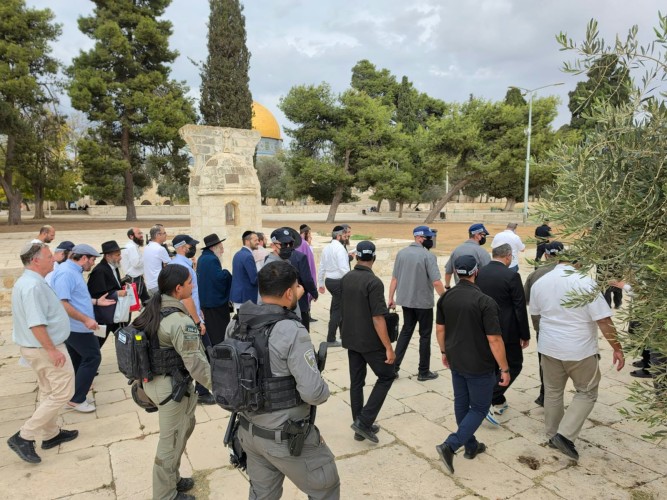
On the eve of the Israeli elections: Ben-Gvir and Feiglin lead incursions and public prayers at Al-Aqsa Mosque
As part of an effort to use the Al-Aqsa Mosque for electioneering, Israeli Minister of National Security Itamar Ben-Gvir and "Zehut" party leader Moshe Feiglin, accompanied by candidates from his electoral list, stormed the Al-Aqsa Mosque on Monday. The incursion took place on the eve of Tuesday’s Israeli elections, under heavy security provided by occupation forces, police, and Ben-Gvir’s personal security detail.
During the incursion, Jewish prayers and religious rituals were openly performed inside the mosque. Settler groups circulated photos and videos of Ben-Gvir praying in the mosque’s courtyards. The act coincided with growing efforts to impose overt Jewish religious practices at the site and to use the mosque in the political discourse of Israeli factions seeking to change the existing status quo.
Settler groups also shared images and footage of Feiglin and several candidates on his list—including Omer Betsianish and Shiriel Lum-Nehir—as they toured the Al-Aqsa courtyards. Feiglin said Al-Aqsa is "the heart, from which everything begins,” placing the mosque at the center of the political rhetoric surrounding his electoral campaign.
This incursion comes as Israel prepares for the 26th Knesset elections, scheduled for Tuesday, October 27, 2026. The events at the mosque on the eve of the vote should be understood in the context of political posturing, particularly by factions advocating for expanded Jewish prayer and religious rituals within the Al-Aqsa compound.
Prayers, religious texts, and the ongoing transformation of the Al-Aqsa Mosque’s reality
In a related development, settler groups released a video showing Rabbi Elisha Wolfson, head of a religious seminary, praising Itamar Ben-Gvir inside the eastern section of the Al-Aqsa Mosque. Wolfson credited Ben-Gvir with bringing about a "massive and historic change to the status quo" since taking office.
Wolfson pointed to what he described as an increase in public prayer, singing, dancing, Talmudic rituals, and Torah study within the mosque. Meanwhile, circulated images showed Ben-Gvir praying with religious texts in front of him, reflecting the recent easing of restrictions on bringing religious books into the Al-Aqsa Mosque and praying there.
From advocating for a synagogue to public prayer and introducing religious texts, each step rapidly reshapes the reality of Al-Aqsa
According to the center’s monitoring, today’s incursion is the twenty-second time Ben-Gvir has entered the Al-Aqsa Mosque since taking office in early 2023. It forms part of a broader pattern of incursions, positions, and statements—alongside concrete actions on the ground—that have enabled an increase in public Jewish prayers and rituals inside the mosque.
In August 2024, Ben-Gvir declared his support for establishing a Jewish synagogue inside the Al-Aqsa Mosque, specifically in its eastern section. The area has recently become a focal point for settlers, who regularly conduct prayers, hold religious lessons, and organize study circles there.
These developments were accompanied by the police allowing settlers to perform rituals and pray in the eastern area of the mosque. Collective prayer, prostration, dancing, singing, and loud chanting of hymns and slogans subsequently spread to other parts of the complex. This followed Ben-Gvir’s June 2025 incursion into Al-Aqsa, during which he asserted what he called the right of Jews to pray anywhere in the mosque—a claim he acted on by praying in several areas of its courtyards. At the same time, the site's facilities were expanded to include prayer sheets, various religious items, and even religious texts; the Israeli flag was also permitted to be raised.
These developments point to a rise in visible Jewish prayer and rituals within the Al-Aqsa Mosque, particularly in its eastern section. They coincide with demands by "Temple" groups to expand the area allocated for Jewish prayer and their explicit calls to change the existing status quo.
Ongoing expulsions target Al-Aqsa’s preachers, imams, and religious figures
As Jewish prayers and rituals become more common at Al-Aqsa Mosque, the occupation authorities continue to issue orders barring Palestinians from the site. Those affected include preachers, imams, religious and national figures, Islamic Endowment employees, and men, women, young people, and the elderly.
These measures have targeted preachers at Al-Aqsa Mosque, including Sheikh Ekrima Sabri, head of the Supreme Islamic Council and a preacher at the mosque. The occupation authorities have barred him from the site since August 2024, and recently renewed the order. Another affected individual is Sheikh Mohammad Hussein, Grand Mufti of Jerusalem and the Palestinian Territories and an Al-Aqsa preacher. Occupation forces arrested him after a Friday sermon and prayer on July 10, 2026. After his release, authorities served him with an expulsion order, later extended for six months until January 10, 2027.
The measures have also targeted Sheikh Khaled Abu Jom’a, an Al-Aqsa preacher arrested on Friday, October 23, after delivering a sermon and leading prayers at the mosque. He was later released under an expulsion order barring him from Al-Aqsa for one week, subject to renewal. This underscores how the mosque’s preachers remain a primary target of these ongoing restrictive measures.
The measures also affected other religious figures, including Sheikh Raed Salah and Sheikh Kamal al-Khatib. Both were summoned to a hearing with the occupation police at al-Qishla station in Jerusalem’s Old City on Monday, October 26. The summonses were part of proceedings to bar them from Al-Aqsa Mosque, and the documents also ordered their immediate expulsion from the mosque until the scheduled hearing.
Amid the targeting and expulsion of Palestinian religious figures from the Al-Aqsa Mosque, the defense team for Sheikh Raed Salah and Sheikh Kamal al-Khatib—lawyers Khaled Zabarqa, Omar Khamaisi, and Ramzi Katailat—called for the cancellation of Monday’s hearing at the al-Qishla police station and the revocation of the seven-day expulsion order barring them from the mosque.
In a letter to the police officer in charge of investigations in the "David" district, the defense team argued that neither the summons nor the expulsion order had any legal basis. They stressed that the entire Al-Aqsa Mosque is an exclusively Islamic Endowment, and that the measures against the two Sheikhs violate freedom of worship and the established historical status quo. They also objected to the expulsion being tied to the Sheikhs' public statements and opposition to Israeli control of the mosque, arguing that this exposed the political motives behind the decision.
These actions come amid continued orders barring preachers, imams, religious authorities, and *murabitin* (those who maintain a presence at the site) from Al-Aqsa, alongside an increase in overt Jewish prayer and rituals in the mosque’s courtyards. The expulsion orders target more than preachers and imams: they also affect men and women who maintain a presence at the site, Islamic Endowment employees, and various figures from Jerusalem. The measures limit their access to the mosque and its surrounding area, preventing many from carrying out their religious and social roles there.
1,000 Expulsion Orders
According to the Wadi Hilweh Information Center – Jerusalem, more than 1,000 orders have been issued since the beginning of this year banning individuals from the Al-Aqsa Mosque and the Old City. This points to an expansion of measures targeting the Palestinian presence at the mosque and in the surrounding areas.
As expulsion orders against Palestinians continue, public Jewish prayers and rituals are increasingly taking place in Al-Aqsa’s courtyards under the protection of occupation police. These developments raise concerns that new realities are being established within the mosque, as both the nature of the incursions and the activities permitted to those entering continue to change.
Against the backdrop of the upcoming elections, incursions by Israeli political leaders should be understood in a broader context: the contest over positions on the Al-Aqsa Mosque. These developments are unfolding alongside continued restrictions on the mosque’s preachers, imams, and those who maintain a constant presence there, even as public Jewish prayer and ritual practices become increasingly common in its courtyards.