Day 3 of Sukkot: 1,780 Settlers, Expanding public religious rituals at Al-Aqsa, and crowds at the Al-Buraq Wall
On Monday, the third day of the Jewish holiday of Sukkot, 1,780 settlers took part in successive, large-scale incursions into the blessed Al-Aqsa Mosque. From the moment they entered through the Dung Gate, they engaged in public group prayers and religious rituals. Participants carried prayer books and sheets, wore religious attire and shirts bearing images and slogans linked to the alleged "Temple," and brought the "Four Species" associated with Sukkot rituals, using them in prayers and ceremonies inside the mosque, particularly in its eastern area.
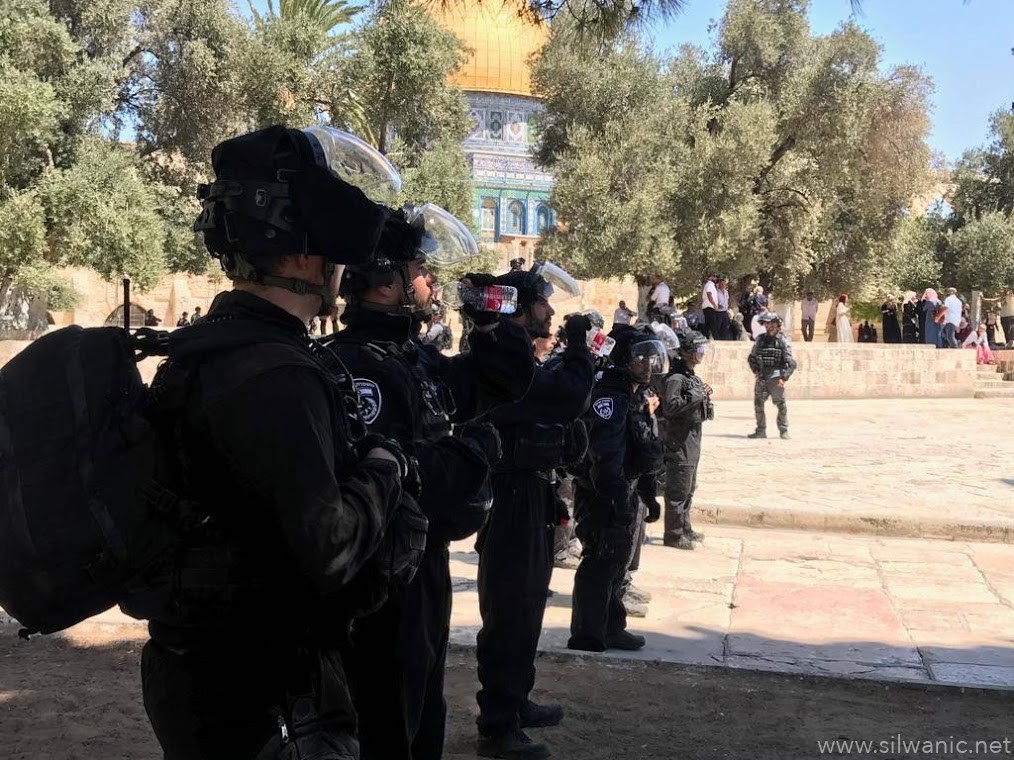
At the same time, occupation forces strictly restricted Muslim access to Al-Aqsa Mosque and the area around the Old City, preventing people in various age groups from reaching the site. Only a small number of worshippers were able to perform the Noon prayer. They were confined to the covered prayer halls, while the open courtyards remained accessible to the intruders and their accompanying forces.
1,780 settlers and consecutive incursions
The Wadi Hilweh Information Center – Jerusalem reported that 1,780 settlers stormed the Al-Aqsa Mosque today. Of these, 1,271 entered during the morning session (6:30 AM to 11:30 AM), and 509 during the afternoon session (1:30 PM to 3:00 PM), through the Dung Gate, whose keys have been controlled by the occupation authorities since Jerusalem was occupied.
The incursions took place in large, consecutive groups, with each group ranging from 90 to 160 individuals; up to five groups were permitted to be present inside the Al-Aqsa Mosque (in various locations) simultaneously.
The Center reported that most settlers completed a full tour of the mosque grounds, beginning at the Dung Gate, passing through the courtyards and the southern, eastern, northern, and western porticoes, and ending at the Al-Silsileh Gate. A smaller number took a shorter route directly from the Dung Gate to the Al-Silsileh Gate, allowing the largest possible number of settlers to enter over six and a half hours.
Additionally, two to three groups were seen taking the eastern route inside Al-Aqsa Mosque as incursions continued in successive waves.
Prayers and rituals from the moment of entry into Al-Aqsa
Video footage shows groups of settlers performing public, collective religious prayers and rituals as soon as they entered the Al-Aqsa Mosque complex through the Mughrabi Gate. They carried religious texts and prayer sheets and wore religious attire; some also wore shirts featuring images and slogans associated with the alleged "Temple."
The footage showed prayers being performed in the courtyards near the Mughrabi Gate and facing the Al-Qibli Mosque. It documented intruders performing religious rituals as soon as they entered the mosque grounds, showing that these practices were not limited to the eastern area.
The eastern area: A hub for prayers and rituals
The eastern area of the Al-Aqsa Mosque has become a key destination for intruders, with successive groups observed heading there to perform religious hymns and rituals aloud.
Although occupation police claim to confiscate these items and detain settlers who bring them into the mosque, settlers still manage to smuggle them in through the Dung Gate, despite security checks before entry.
The repeated entry of these items and their use in rituals inside the mosque raise questions about inspection mechanisms and the measures taken against those who storm the site. Some individuals manage to bring religious objects and materials into Al-Aqsa and use them for prayers and rituals, only for police to later announce that the items have been confiscated and those carrying them detained.
This phenomenon has not been confined to the plant species associated with the Sukkot holiday; it has also recurred during other Jewish occasions and holidays. Examples include introducing and using the shofar (ram's horn) during Rosh Hashanah, as well as using tefillin on previous occasions—items that police later banned and, in some instances, confiscated. This progression reflects a shift from merely trying to bring these items in to performing rituals with them inside the mosque, followed by official announcements of measures taken against those who used them.
Recently, the eastern area has become a frequent gathering place for settlers’ collective prayers and rituals. They remain there for extended periods, prostrating and praying publicly—activities that extend beyond the brief passage of a standard incursion route. Instead, they signal an effort to establish the area as a permanent religious site within Al-Aqsa Mosque—effectively an "undeclared synagogue." These practices are no longer limited to one spot: prayers and gatherings now extend along the incursion route, across the stone terraces and into wooded areas, reaching the vicinity of the Bab al-Rahma prayer hall.
This comes amid repeated instances of religious ritual items being brought into Al-Aqsa Mosque and public acts of worship being performed there during the holiday season—practices often concentrated in the mosque's eastern area.
"Temple-Building" and "Hammering" T-shirts
T-shirts bearing slogans and images linked to the alleged "Temple" continue to appear within the Al-Aqsa Mosque courtyards. Settlers have been seen wearing shirts with phrases such as "To the House of the Lord We Go" and "Hammers Will Resound Therein," alongside illustrations of cranes, construction equipment, and heavy machinery.
These images depict the demolition, construction, and alteration of the mosque’s features; such shirts have been worn during settler incursions into the Al-Aqsa courtyards.
Ben-Gvir leads singing and dancing circle inside Al-Aqsa
Israeli National Security Minister Itamar Ben-Gvir stormed the Al-Aqsa Mosque today, leading settlers in a circle of dancing, singing, and religious chanting within the mosque's western portico while chanting "The Temple Will Be Built." In the eastern area, he engaged in group prayer, holding prayer sheets during the ritual.
Today’s incursion marks the 21st time Ben-Gvir has stormed the Al-Aqsa Mosque since assuming office in early 2023.
The presence of Israeli government ministers during these incursions highlights political figures’ participation in activities inside the mosque, as well as the continuation of public prayers and rituals during the Sukkot holiday.
During the incursion, Ben-Gvir explicitly declared, "We are the sovereign power here on the Temple Mount [Al-Aqsa Mosque]." He boasted that he had broken what he called "old rules" and established the public performance of prayers and Talmudic rituals. He added, "Hamas launched the 'Al-Aqsa Flood,' but today *we* are the sovereign power," and asserted that, after three years, the "People of Israel" are on the path to total victory.
He also used the occasion to boast about the measures he has imposed on Palestinian prisoners, including torture and severe restrictions, and noted that he has made their detention conditions significantly harsher.
Furthermore, he took credit for distributing weapons to settlers and forming what he called armed "local squads."
Clearing Al-Aqsa of worshippers and tightened restrictions at the gates
Alongside the incursions, occupation forces tightened restrictions on Muslim access to Al-Aqsa Mosque, barring people in several age groups. As a result, only a small number managed to reach the mosque for the Noon prayer.
The forces designated specific areas for worshippers inside the covered prayer halls, while the mosque courtyards remained closed to Muslim worshippers and open instead to settlers and their accompanying forces—even as prayers and rituals continued there.
Furthermore, the gates of Al-Aqsa Mosque and the entrances to the Old City took on the appearance of a military barracks, with a heavy troop presence and strict restrictions on Palestinian movement as incursions continued.
Prayers at the gates and Mosque’s perimeter
The activities extended beyond the interior of Al-Aqsa Mosque: settlers gathered in large numbers near the al-Silsileh Gate and the Buraq Wall, where they held collective prayers.
This coincided with the "Priestly Blessing" ceremony at the Buraq Wall plaza. According to Israeli reports, more than 50,000 worshippers took part in the event during the Sukkot (Feast of Tabernacles) holiday, led by senior rabbis, Defense Minister Israel Katz, and Minister Itamar Ben-Gvir.
Since morning, occupation police had also closed roads leading to the Mughrabi Gate, the Buraq Wall, and the Silwan area as part of security measures accompanying settler movements and collective prayers around the Old City.
Extremist "Temple" groups continue to call for incursions into the Al-Aqsa Mosque during the remaining days of Sukkot, which ends this week.
The series of Jewish holidays began with Rosh Hashanah (the Hebrew New Year) on September 12–13, followed by Yom Kippur on September 21–22. Sukkot began on September 26 and continues through October 2, concluding on October 3 with the "Simchat Torah" (Rejoicing of the Torah) celebration.