Al-Aqsa faces a new test: 15 intruders and religious texts "Siddur" after two years of escalating Jewish rituals
The Al-Aqsa Mosque is experiencing a continuous increase in the enforcement of Jewish religious rituals within its grounds. What was once limited to settler visits and tours is now gradually shifting toward establishing a structured and public Jewish religious presence in the mosque. This progress is facilitated by measures that have broadened the scope of prayer and rituals, culminating in the permission to bring religious texts and books into the courtyards and to conduct public ritual practices, all supported, protected, and approved by the occupation police.
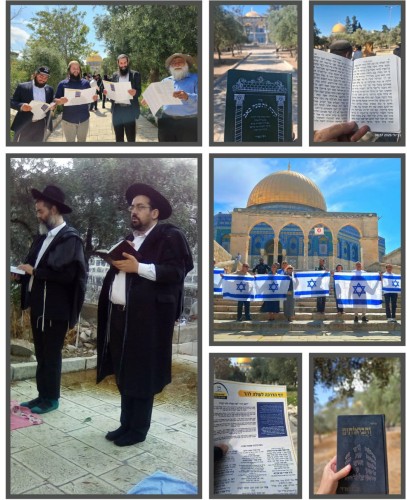
Recently, extremist groups on the Temple Mount announced that occupation police have authorized settlers to bring Talmudic prayer books ('siddur') into the Al-Aqsa Mosque and conduct public religious rituals in its courtyards. This marks a transition from solely permitting prayer to allowing religious books and tools to be brought inside.
15 intruders… “Initial experiment” to bring prayer books
Extremist groups on the Temple Mount claimed that occupation authorities allowed settlers to openly bring Talmudic prayer books (Siddur) and conduct rituals in the courtyards of Al-Aqsa Mosque.
The groups stated that the move was personally approved by occupation police commissioner Danny Levy, who authorized a specific list of just 15 intruders permitted to bring prayer books into the mosque.
The move was characterized as an “initial experiment” intended to assess regional responses and explore the potential to establish and permanently adopt this practice within the mosque.
The Temple Mount groups view this step as just one part of their ongoing agenda, as they have called for additional permissions for settlers during incursions. This includes allowing the entry of religious items used for prayer, such as “tefillin”.
This step indicates a further progression in the enforcement of Jewish rituals at Al-Aqsa, after initially permitting settlers to enter for prayer, they are now allowed to bring their prayer texts. The next request is to also include the tools used for worship.
From prayer sheets to religious books: How did things get to this point?
The permission to bring in "siddur" (a type of Jewish prayer mat) didn't appear suddenly, but rather came within a series of gradual changes that Al-Aqsa Mosque has witnessed over the past two years.
According to monitoring and documentation by the Wadi Hilweh Information Center – Jerusalem, Jewish religious rituals inside the mosque have shifted from limited and individual attempts to more public and organized practices, then to allowing the entry of religious materials, and finally to books used in prayer.
August 2024: The Synagogue idea proposed
In August 2024, Israeli National Security Minister Itamar Ben-Gvir announced plans to establish a synagogue in the eastern part of the Al-Aqsa Mosque.
Since that announcement, the area has seen a steady increase in public Jewish prayer activities, gradually becoming a daily venue for group prayers, educational sessions, and gatherings on chairs and platforms. According to the Wadi Hilweh Information Center in Jerusalem, these gatherings typically last between 20 and 40 minutes during incursions.
The settlers' presence in the eastern part has evolved from mere passage along the incursion route to the establishment of new patterns of activity. These now include prayer, sitting, gathering, and holding sessions, gradually transforming the area into a space for Jewish religious practices within the mosque. This trend persisted through July 2026, aligning with the so-called "anniversary of the destruction of the Temple," when a canopy was set up in the eastern area. This was part of an effort to facilitate the intruders' presence and their practices in the area.
At the same event, the mosque saw a notable increase in the number of intruders and in religious ceremonies, with Ben-Gvir taking part and openly performing prayers, prostrations, and Talmudic rituals.
June 2025: Prayer spreads in Al-Aqsa courtyards
In June 2025, prompted by Ben-Gvir, Jewish prayer spread to multiple parts of the Al-Aqsa Mosque compound. It was carried out collectively and loudly, marking an unprecedented scale of rituals within its courtyards.
Therefore, the practices evolved from isolated efforts into regular, organized rituals carried out during incursions and under the supervision of the occupation police.
January 2026: Prayer papers introduced
In January 2026, settlers were allowed for the first time to bring prayer papers into the Al-Aqsa Mosque. These papers included religious texts and instructions, as well as slogans from Temple Mount groups.
This step marked a major change: prayer was no longer restricted to what the intruder memorized or recited aloud from their mobile phone. Instead, they began using religious materials specifically designed for use inside the mosque.
April 2026: Expanded prayer texts
At the end of April, extremist groups on the Temple Mount announced the release of expanded prayer texts for use during incursions into the Al-Aqsa Mosque compound. This move indicates an escalation in public religious rituals within the courtyards.
This expanded the variety of religious materials allowed inside the mosque, and these texts became integral to the practice that Temple Mount groups aim to establish within Al-Aqsa.
May 2026: Flags, anthems, and prayers
In May 2026, tensions escalated when Israeli National Security Minister Itamar Ben-Gvir displayed the Israeli flag within the Al-Aqsa Mosque and led settlers in chanting anthems and prayers. This event merged religious rituals with expressions of Israeli nationalism. Follow-up footage showed settlers raising the flag inside the mosque and performing prayers and religious rituals together.
Raising the flag, publicly performing prayers, and reciting anthems and prayers are no longer activities solely linked to Ben Gvir’s participation. Instead, these acts have later become common collective practices among settlers during their incursions, often under the protection of the occupation police.
July 2026: "The Commemoration of the Destruction of the Temple"
In July 2026, religious rituals reached a new high, aligning with what extremist Jewish groups refer to as "the commemoration of the destruction of the Temple."
On this occasion, religious books were openly brought into Al-Aqsa Mosque for the first time. Prayers were performed inside the mosque, and the area saw the reading of the Book of Lamentations, a Jewish religious text of five chapters, recited on the ninth of Av, which coincides with the commemoration of the "destruction of the Temple."
As a result, the rituals expanded beyond prayer or prostration to include reading religious texts relevant to the specific occasion the groups sought to commemorate inside the mosque.
Ben-Gvir… A series of concessions
These developments coincided with a series of statements and actions by Israeli National Security Minister Itamar Ben-Gvir, who repeatedly expressed support for increasing Jewish prayer and rituals at the Al-Aqsa Mosque.
From his announcement to establish a synagogue within the mosque, through expanding public prayer activities and easing access to prayer materials and texts, these practices have gradually increased.
Ben-Gvir's role in these activities should not be viewed as just an isolated incident. Over time, it becomes clear that what starts with the minister's personal participation or involvement in a ritual at the mosque soon turns into a regular practice by settlers, gradually becoming accepted as an established fact.
It is noteworthy that each stage, which initially seemed limited in scope, has now become a foundation for progressing to the next phase.
Therefore, the minister's presence and ritual performances at Al-Aqsa serve as a political and practical cue for what might be accepted within the mosque. What initially appeared as an overreach or an extraordinary practice gradually becomes repeated, then extended to a group of settlers, eventually aiming to establish it as a normal part of incursions.
This pattern occurs in the rituals at Al-Aqsa Mosque: an extremist official or political figure initiates a step, followed by settler groups, and then the practice becomes a regular occurrence accepted by the occupation police.
Ben-Gvir's involvement in these rituals is crucial, not just because of his actions inside the mosque, but also because it creates room to expand and solidify these practices among the intruders.
What do the Temple Mount groups demand next?
The demands from extremist groups go beyond permitting “Siddur” books; they also include other religious items, especially tefillin.
This indicates that the inclusion of books is not an isolated action but part of a larger effort to embed Jewish rituals into Al-Aqsa Mosque.
From a “Preliminary Experiment” to a Permanent Reality?
The risk associated with this recent event stems from the terminology employed by the Temple Mount groups: "a preliminary experiment.” Although they plan to restrict the number of intruders to 15, this does not guarantee the procedure will stay within that limit. Instead, these groups are openly considering testing reactions and exploring the potential to establish and eventually broaden this approach.
Therefore, what is occurring should not be seen as an isolated event but as a new stage in an ongoing process. It started with individual prayer attempts, progressed to public and organized prayers, then incorporated papers and texts, and eventually led to the publication of religious books.
This trajectory's danger is that what begins as a limited exception or temporary experiment slowly becomes a regular practice and eventually a de facto reality that the Temple Mount groups aim to establish and broaden.
From prayer papers to books and from books to religious objects, the rituals progress further within Al-Aqsa, as the demands grow to establish a new religious reality in the mosque